
Into The Lesbian Vortex
- Dec 23, 2025
- 9 min read
Updated: Apr 13
An edited version of this story appeared on 11/12 April 2026 in
See below.

"As long as I have breath in my lungs, I will love. And even after." - Sappho
It is hot and dry in the centre of Lesbos. Greece has been suffering from a five year drought and the cool creeks that once gurgled around the Sanctuary at Messon have been reduced to mere trickles. We are at a 6th century BC temple dedicated to Zeus, Hyra and Dionysus - the Lesbian Triad, otherwise known as the Immortal Blissful Gods.
I take refuge in the shade of a thirsty tree and read from the only surviving poem written by the feminist icon Sappho who was born on this island around 600 BC. Deep time reverberates through my bones as I speak verses penned by “The Poetess”, as Plato called her. To think that she might have recited these very words on this exact spot some 2,600 years ago!
Sappho was, and still is revered worldwide for being one of the very first European women to commit her inner passions and same sex attraction to the page. She would perform her poetry accompanying herself on the lyre, and send audiences into raptures. They raised statues in her honour and in the 2nd century BC coins were minted with her image imprinted on them.
But according to the Poetry Foundation, Sappho ‘challenge[d] the heroic ethos that buttressed patriotism’, and so it was that male comedians began deriding her. In 180 AD, centuries after her death, the theologian Tatian called her "a whore who sang about her own licentiousness." Finally Saint Gregory of Nazianzus and Pope Gregory VII ordered her work be burned.
Less than two percent survives today in just 264 fragments, 63 complete lines and that one precious poem - words cobbled together from papyrus wrapped around Egyptian mummies first discovered in the 1800s. They are still being unearthed by papyrologists today in the rubbish dumps of Oxyrhynchus.

Like Sappho’s poetry, little remains of the original temple at Messon. Stumps of volcanic rock columns from a later temple, one of the first examples of ancient Ionian Greek architecture, mark out the original building. I circumambulate the site in wonder. Its early pan-Lesbian history is said to have included beauty pageants and fertility rites at which the illusive muse could well have woven her sonic spells.
Aristotle would have trodden these pathways too. The philosopher lived here on the north coast of the Gulf of Kallori between 346 - 343 BCE, studying wildlife including the flocks of flamingos that can still be seen nuzzling around the salt marshes for small crustaceans. No doubt he would have feasted on the prized local pappalines sardines which are still rated the best in Greece.
I am on the island to attend the 25th International Women’s Festival at Skala Eressos on the south western coast of the island where Sappho was supposedly born - either here or in the capital of Mitelene, an hour and a-half’s drive east where the airport now is, and where you can catch a two-hour ferry ride to Turkey.
All the accommodation has been booked out way in advance so our Australian delegation stays in the picturesque seaside town of Tevari. Our brand new stone fortress-like house on the headland has windows on all sides overlooking the bedazzling sea. What exactly is that blue? It has been called 'glaukos', a glimmering bluish green colour. Whatever it is, it looks epic set against the stoney sienna landscape. They say that in Spring the ground is carpeted with wild flowers. Now in early Autumn it is stark and windswept. Way off on the horizon the volcanic peak of the island of Chios can be seen shimmering in the heat.

We are half-an-hour's drive from the Festival site so we hire a car with the Sappho Travel agency. I am designated driver which of course means navigating on the other side of the car and road from our Australian system. The gnarly hair-pin bends up and over the mountain are challenging, especially after dark or when suddenly confronted by a flock of sheep.
A team of volunteers buzz around in the Festival office where our wrist bands await us. 125 Euro gets us each access to most events across the fortnight and the program is packed. Every day there are more than a dozen activities to choose from beginning with an offering of yoga and winding up with a DJ set in one of the many waterfront bars.
1500 women from all over the world have converged here and the place is throbbing. Repeat offenders are reconnecting with old friends and most of the tavernas have few seats left on their summer decks perched out over the beach. We find a comfy couch at one called Par A Sol and order a cool drink.
About 500 metres offshore is a massive rock which at night is lit up like a ghost ship. Weekdays start with a swim out to this landmark with support teams in kayaks keeping an eye out for those who might need help. This is not a competition. The water is clear and calm. How to accurately describe that colour? Not bottle blue but glassy for sure. Floating on my back, I admire the sight of some sporty girls who have climbed to the top of The Rock to pose with the Greek flag.
Back on the stony beach, first-timers including us gather in a circle to be inducted into the Skala Women's Rock Group School of Sappho. 'Step into your Destiny with Pride' is the motto on the lanyard awarded to new members.

There is no escaping the Poetess. Even the Festival hub is called 'Sappho's Temple' and it occurs to me that if gay men were in charge there would be a lot more fairy lights and glitter. Still, it is a functional enough space for the daily workshops on everything from singing, to flirting, to Greek erotic mystagogy. It is elevated and catches a welcome breeze off the sea as we move around in our first Nia class.
Free dancing comes easily to me but for many other women they are only just now exploring their movement capabilities and by the look on their faces they appear to be enjoying the experience. Women of all ages mingle in this safe space, free from the male gaze, and yes, it is liberating.
Presumably women have been coming here in search of inspiration for many centuries. But the phenomenon of seasonal lesbians descending on the town really kicked off during the 1980s and 90s. The documentary Lesvia traces the evolution of Skala Eressos as a mecca for lesbians and it screens at the Cine Sappho Magicnights, a large outdoor theatre which doubles as a performance venue for the Festival.
Under the star-spangled northern sky we watch classic footage of early European pioneers arriving in search of Sapphic sisterhood. These women discovered that nude bathing on the black volcanic sands was quite appealing and swimming in that ultramarine (?) sea was rather fabulous too. For nature lovers there were wetlands behind the beach where small river turtles gathered in their hundreds and Loggerhead sea turtles also nested nearby. And after all that they could drink cocktails while watching the sun set over the Aegean. It was pure paradise for these early adopters escaping their colder climes. And word soon got around.
Lesvia features interviews with locals who at first were not so impressed by the influx. So many women flagrantly displaying affection for one another in public places was confronting. "They shouldn't call themselves lesbians," one Greek woman complains, "I'm a lesbian. I come from here! They should call themselves 'homosexuals'."

The word 'lesbian' to describe gay women only began in 1875 when Beaudelaire's poem "Delphine and Hippolyte" was referred to as 'lesbian' by the critic George Saintsbury. Weirdly, the Greek verb 'lesbiazein' means to fellate which is certainly not what lesbians do. So while what the natives call themselves and everything else originating from their island has been co-opted, they seem to have resigned themselves to it and are now more than a little pleased with the income that all these women pass on to them during this fortnight of femme focused activities.
Quite apart from its Sapphic associations, Lesbos is renowned for its natural wonders. 20 million years ago, a series of volcanos erupted on the western side of the island covering a forest of massive conifers and other trees in lava and ash. Over the aeons their wooden trunks were replaced by silica carbonate and the excavated site, full of agate-like stumps, is now part of the UNESCO Global Geoparks Network. The Petrified Forest also has a sub- marine site that you can view from a glass-bottom boat.
Due to its location on a tectonic fault line, the island has many hot springs in which you can loll about. The Landscapes of Sappho Tour takes us to Polichnitos where the water bubbles up through ignimbrites, the most recent volcanic rocks on Lesbos. Water temperatures here can reach 87.6 degrees centigrade which makes it the warmest natural spring in Europe. Underground near the magma it is 400 degrees! Under the eucalypt trees at the brand new Mythical Coast Wellness Retreat the sodium-rich water in the circular stone pools is much more accommodating.

Our guide takes us to her favourite restaurant at Achladeri where we sit at a long table on the verandah overlooking the Kalloni Gulf to feast on fresh fish which we are invited to hand-pick from the kitchen. Sardines, Greek salad with feta, a giant bean dip, grilled squid and red snapper - it’s hard to go wrong.
My third cousin lives on Lesbos for most of the year caring for abandoned dogs and cats which, once vaccinated, chipped and readjusted to domestic life, are couriered to new homes in England. We meet the latest batch of furry friends at her whitewashed house in Skalochori, a remote village that she fell in love with while exploring the island many decades ago. After patting each pet, she instructs us to try her favourite restaurant, Octopus, on the port at Molyvos an hour and a-half’s drive north.
Set right on the waterfront beneath the imposing Byzantine Castle of Mithymna, Octopus has tentacles hanging on wires strung around its eaves. Large specimens are dried in the sun for eight hours then grilled to perfection in under ten minutes. The restaurant serves up its namesake in fine style with our waiter even cutting it into thin slices for our delectation.

We drive back to Skala just in time for the Alternative Fashion Show, an annual highlight of the Women’s Festival. Participants whose faces we’ve come to recognise are showcasing a range of clothing in this special event staged to raise funds for stray animals. There is a small dog called 'Free' who belongs to no-one in town but is cared for by all as she trots from house to house. One woman sings an ode to her accompanied by a slide show that pulls on the heartstrings.
I overhear some women complain that too much effort goes into animals rather than caring for all the refugees that wash up on these shores while fleeing conflicts in their home countries. Some asylum seekers from Syria have settled in Eressos and have brought with them skills as seamstresses and tailors. Their garments, made using recycled materials, receive huge applause on the catwalk.

On Day 10 a quartet of lesbian thespians sails into Skala’s protected bay on Lafri, a yacht named after the south-westernmost tip of Lesbos. We encounter the four young women on the promenade inviting guests to their pop-up performance near the chapel just beyond the harbour. Arriving early we step carefully over the slippery rocks and ease ourselves into the cool water for a pre-show swim.
As the performers take their places we go to get out but they encourage us to stay submerged. "That's the best place to see the show," says their leader Daniela Marcozzi of the Berlin-based Marcozzi Contemporary Theatre. We float closer to the front row while a small crowd gathers in the shade of the chapel.
Their site-specific performance starts with experimental sounds and expressive movement along the foot of the weather-beaten cliffs, studded with ancient boulders. We paddle along with them as they splash around in the water and crawl onto a rock where they sing the praises of mermaids, nature and of course Sappho.
An electric blue kingfisher flies in, attracted by their strange sounds. Alcedo atthis is named after Atthis, a woman of Lesbos greatly admired by Sappho. The bird is also revered in a Greek myth about Alcyone and her husband Ceyx who were turned into kingfishers or "halcyon birds" that calm the seas so that sailors can find safe passage.
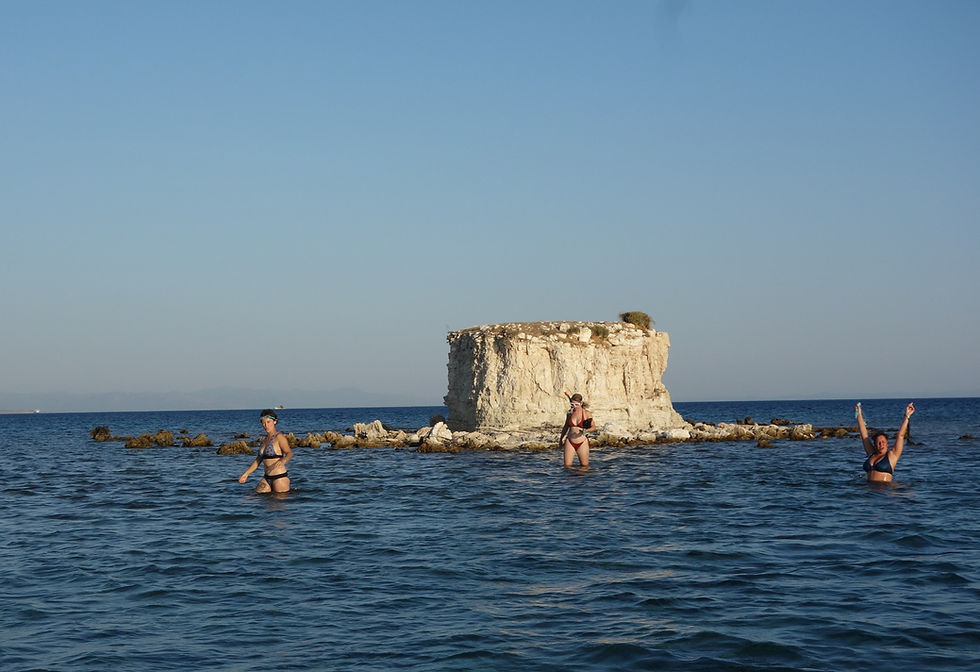
On our final day, we go for a sail on Lafri along the rugged southern coast of the island. Still baffled by that colour, I consult the skipper. “Is it ‘Aegean blue?”. He nods. What else could it be? It’s the stuff of legends. We drop anchor in a protected cove and I dive off the back of the yacht right into the depths of it.
An Ionic column from an ancient temple dedicated to Artemis is said to lurk here. As I search the grottos for the relic it seems as if the volcanic black boulders clanking together with the swell are trying to tell me something; ‘Here you are, on my coastline, living your best life. Tomorrow you will be gone. But we are forever connected now’. A local woman expresses the same sentiment to me; “For two weeks this has been your playground. You will all leave and we will have to integrate the experience somehow. Don’t forget us, will you?”. How on Earth could we? In fact, can we stay?

Here's how the story appeared in The Australian's Travel and Luxury section 11/12 April 2026:


